Tokyo People Eating Dogs Tokyo Kawii Fashion
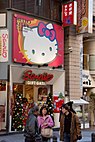

Kawaii (Japanese: かわいい or 可愛い, IPA: [kawaiꜜi]; 'lovely', 'loveable', 'cute', or 'adorable') [ane] is the culture of cuteness in Nihon.[ii] [iii] [4] Information technology can refer to items, humans and not-humans that are charming, vulnerable, shy and artless.[2] Examples include beautiful handwriting, sure genres of manga, and characters including Hello Kitty and Pikachu.[5] [6]
The cuteness culture, or kawaii artful, has become a prominent aspect of Japanese popular civilisation, amusement, habiliment, nutrient, toys, personal appearance, and mannerisms.[7]
Etymology [edit]
The discussion kawaii originally derives from the phrase 顔映し kao hayushi, which literally ways "(one'southward) face (is) aglow," normally used to refer to flushing or blushing of the face. The 2nd morpheme is cognate with -bayu in mabayui (眩い, 目映い, or 目映ゆい) "dazzling, glaring, blinding, besides bright; dazzlingly beautiful" (ma- is from 目 me "eye") and -hayu in omohayui (面映い or 面映ゆい) "embarrassed/embarrassing, awkward, feeling cocky-conscious/making one feel self-conscious" (omo- is from 面 omo, an primitive give-and-take for "face up, looks, features; surface; paradigm, semblance, vestige"). Over time, the meaning changed into the modernistic meaning of "cute" or "shine" , and the pronunciation changed to かわゆい kawayui so to the mod かわいい kawaii.[eight] [ix] [10] Information technology is unremarkably written in hiragana, かわいい , but the ateji, 可愛い , has also been used. The kanji in the ateji literally translates to "able to dearest/be loved, can/may honey, lovable."
History [edit]
Original definition [edit]

Kogal daughter, identified by her shortened skirt. The soft bag and teddy bear that she carries are function of kawaii.
The original definition of kawaii came from Lady Murasaki's 11th century novel The Tale of Genji, where it referred to pitiable qualities.[11] During the Shogunate period[ when? ] under the credo of neo-Confucianism, women came to be included under the term kawaii as the perception of women being animalistic was replaced with the formulation of women every bit docile.[xi] However, the before pregnant survives into the modern Standard Japanese adjectival noun かわいそう kawaisō (often written with ateji every bit 可哀相 or 可哀想) "piteous, pitiable, arousing compassion, poor, deplorable, distressing" (etymologically from 顔映様 "face up / projecting, reflecting, or transmitting calorie-free, flushing, blushing / seeming, appearance"). Forms of kawaii and its derivatives kawaisō and kawairashii (with the suffix -rashii "-like, -ly") are used in mod dialects to hateful "embarrassing/embarrassed, shameful/ashamed" or "good, prissy, fine, excellent, superb, splendid, admirable" in improver to the standard meanings of "adorable" and "pitiable."
Beautiful handwriting [edit]
In the 1970s, the popularity of the kawaii artful inspired a manner of writing.[12] Many teenage girls participated in this style; the handwriting was made by writing laterally, often while using mechanical pencils.[12] These pencils produced very fine lines, every bit opposed to traditional Japanese writing that varied in thickness and was vertical.[12] The girls would likewise write in large, round characters and they added little pictures to their writing, such as hearts, stars, emoticon faces, and letters of the Latin alphabet.[12]
These pictures made the writing very difficult to read.[12] Every bit a upshot, this writing style acquired a lot of controversy and was banned in many schools.[12] During the 1980s, however, this new "beautiful" writing was adopted by magazines and comics and was frequently put onto packaging and advertising[12] of products, specially toys for children or "cute accessories".
From 1984 to 1986, Kazuma Yamane ( 山根一眞 , Yamane Kazuma ) studied the development of the beautiful handwriting (which he chosen Dissonant Female Teenage Handwriting) in depth.[12] This type of beautiful Japanese handwriting has as well been called: marui ji ( 丸い字 ), meaning "round writing", koneko ji ( 小猫字 ), meaning "kitten writing", manga ji ( 漫画字 ), meaning "comic writing", and burikko ji ( 鰤子字 ), meaning "fake-child writing".[13] Although it was commonly idea that the writing fashion was something that teenagers had picked upwardly from comics, Kazuma found that teenagers had come up with the style themselves, spontaneously, equally an 'surreptitious trend'. His conclusion was based on an ascertainment that cute handwriting predates the availability of technical ways for producing rounded writing in comics.[12]
Cute merchandise [edit]
Tomoyuki Sugiyama ( 杉山奉文 , Sugiyama Tomoyuki ), writer of Cool Japan, says cute mode in Japan can exist traced back to the Edo period with the popularity of netsuke.[14] Illustrator Rune Naito, who produced illustrations of "large-headed" (nitōshin) infant-faced girls and drawing animals for Japanese girls' magazines from the 1950s to the 1970s, is credited with pioneering what would become the culture and aesthetic of kawaii.[15]
Because of this growing trend, companies such every bit Sanrio came out with merchandise similar Howdy Kitty. Hello Kitty was an firsthand success and the obsession with beautiful connected to progress in other areas also. More recently, Sanrio has released kawaii characters with deeper personalities that entreatment to an older audience, such as Gudetama and Aggretsuko. These characters have enjoyed strong popularity as fans are fatigued to their unique quirks in addition to their cute aesthetics.[16] The 1980s also saw the ascent of beautiful idols, such as Seiko Matsuda, who is largely credited with popularizing the trend. Women began to emulate Seiko Matsuda and her cute manner fashion and mannerisms, which emphasized the helplessness and innocence of immature girls.[17] The market for cute trade in Japan used to exist driven by Japanese girls between 15 and 18 years old.[18]
Aesthetics [edit]

Kawaii is also a ordinarily used word: この犬は可愛すぎる! kono inu wa kawaisugiru! "This dog is too cute!" Toy Poodle wearing apparel in Tokyo Ueno Park
Soichi Masubuchi ( 増淵宗一 , Masubuchi Sōichi ), in his work Kawaii Syndrome, claims "cute" and "not bad" have taken precedence over the former Japanese aesthetics of "beautiful" and "refined".[11] As a cultural miracle, cuteness is increasingly accepted in Japan equally a office of Japanese civilization and national identity. Tomoyuki Sugiyama ( 杉山奉文 , Sugiyama Tomoyuki ), author of Cool Japan, believes that "cuteness" is rooted in Japan's harmony-loving civilisation, and Nobuyoshi Kurita ( 栗田経惟 , Kurita Nobuyoshi ), a folklore professor at Musashi Academy in Tokyo, has stated that "cute" is a "magic term" that encompasses everything that is acceptable and desirable in Japan.[19]
Gender operation [edit]
Japanese women who feign kawaii behaviors (due east.g., high-pitched voice, squealing giggles[20]) that could exist viewed equally forced or inauthentic are called burikko and this is considered a gender performance.[21] The neologism developed in the 1980s, perhaps originated by comedian Kuniko Yamada ( 山田邦子 , Yamada Kuniko ).[21]
Physical bewitchery [edit]
In Japan, being cute is acceptable for both men and women. A trend existed of men shaving their legs to mimic the neotenic look. Japanese women oft attempt to act cute to attract men.[22] A study by Kanebo, a cosmetic company, found that Japanese women in their 20s and 30s favored the "cute look" with a "childish circular face".[14] Women likewise employ a look of innocence in social club to further play out this thought of cuteness. Having large eyes is one aspect that exemplifies innocence; therefore many Japanese women attempt to alter the size of their eyes. To create this illusion, women may wearable large contact lenses, false eyelashes, dramatic eye makeup, and even have an East Asian blepharoplasty, commonly known as double eyelid surgery.[23]
Idols [edit]

Japanese idols ( アイドル , aidoru ) are media personalities in their teens and twenties who are considered particularly bonny or beautiful and who will, for a period ranging from several months to a few years, regularly appear in the mass media, due east.g. as singers for pop groups, flake-part actors, TV personalities (tarento), models in photo spreads published in magazines, advertisements, etc. (Simply non every young glory is considered an idol. Young celebrities who wish to cultivate a rebellious epitome, such as many rock musicians, pass up the "idol" label.) Speed, Morning time Musume, AKB48, and Momoiro Clover Z are examples of pop idol groups in Japan during the 2000s & 2010s.[24]
Cute manner [edit]
Lolita [edit]

Lolita fashion is a very well-known and recognizable style in Japan. Based on Victorian fashion and the Rococo catamenia, girls mix in their ain elements along with gothic style to achieve the porcelain-doll await.[25] The girls who wearing apparel in Lolita manner try to look beautiful, innocent, and cute.[25] This look is accomplished with lace, ribbons, bows, ruffles, bloomers, aprons, and ruffled petticoats. Parasols, chunky Mary Jane heels, and Bo Peep collars are as well very pop.[26]
Sugariness Lolita is a subset of Lolita way that includes fifty-fifty more ribbons, bows, and lace, and is oftentimes made out of pastels and other light colors. Head-dresses such as giant bows or bonnets are too very common, while lighter make-up is sometimes used to achieve a more natural look. Curled hair extensions, sometimes accompanied by eyelash extensions, are also popular in helping with the infant doll look.[27] Another subset of Lolita fashion related to "sweet Lolita" is Fairy Kei.
Themes such as fruits, flowers and sweets are often used every bit patterns on the fabrics used for dresses. Purses often go with the themes and are shaped equally hearts, strawberries, or blimp animals. Baby, the Stars Shine Vivid is one of the more popular clothing stores for this mode and often carries themes. Mannerisms are also of import to many Sweet Lolitas. Sweet Lolita is sometimes non only a manner, but also a lifestyle.[27] This is evident in the 2004 moving-picture show Kamikaze Girls where the main Lolita character, Momoko, drinks but tea and eats only sweets.[28]
Gothic Lolita, Kuro Lolita, Shiro Lolita, and Military Lolita are all subtypes, also, in the United states Anime Convention scene Coincidental Lolita.
Decora [edit]
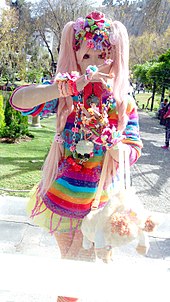
Example of Decora fashion
Decora is a manner that is characterized by wearing many "decorations" on oneself. It is considered to be self-decoration. The goal of this manner is to become equally vibrant and characterized as possible. People who take part in this way trend wear accessories such equally multicolor hair pins, bracelets, rings, necklaces, etc. By adding on multiple layers of accessories on an outfit, the way trend tends to have a childlike appearance. It also includes toys and multicolor clothes. Decora and Fairy Kei accept some crossover.
Kawaii men [edit]
Although typically a female-dominated fashion, some men partake in the kawaii tendency. They transform themselves into women—specifically kawaii women—by wearing wigs, false eyelashes, applying makeup, and wearing kawaii female clothing.[29] This is seen predominately in male entertainers, such as Torideta-san, a DJ who transforms himself into a kawaii woman when working at his nightclub.[29]
Japanese popular stars and actors ofttimes have longer hair, such equally Takuya Kimura of SMAP. Men are also noted as often aspiring to a neotenic look. While it doesn't quite fit the exact specifications of what cuteness means for females, men are certainly influenced by the aforementioned societal mores - to exist attractive in a specific sort of way that the society finds acceptable.[30] In this style both Japanese men and women conform to the expectations of Kawaii in some way or another.
Products [edit]
The concept of kawaii has had an influence on a diversity of products, including candy, such every bit How-do-you-do-Chew, Koala'southward March and Hullo Panda. Cuteness tin exist added to products by adding cute features, such as hearts, flowers, stars and rainbows. Cute elements tin be institute almost everywhere in Japan, from big business to corner markets and national government, ward, and town offices.[22] [31] Many companies, big and pocket-size, employ beautiful mascots to present their wares and services to the public. For example:


- Pikachu, a grapheme from Pokémon, adorns the side of ten ANA passenger jets, the Pokémon Jets.
- Asahi Bank used Miffy (Nijntje), a character from a Dutch serial of children's flick books, on some of its ATM and credit cards.
- The prefectures of Japan, also as many cities and cultural institutions, have cute mascot characters known as yuru-chara to promote tourism. Kumamon, the Kumamoto Prefecture mascot, and Hikonyan, the city of Hikone mascot, are among the about popular.[32]
- The Japan Postal service "Yū-Pack" mascot is a stylized mailbox;[33] they also use other beautiful mascot characters to promote their various services (amid them the Postal Savings Banking company) and have used many such on postage stamps.
- Some constabulary forces in Japan have their own moe mascots, which sometimes adorn the front of kōban (police boxes).
- NHK, the public broadcaster, has its own beautiful mascots. Domokun, the unique-looking and widely recognized NHK mascot, was introduced in 1998 and speedily took on a life of its own, appearing in Internet memes and fan art around the world.
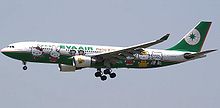
- Sanrio, the company behind Hello Kitty and other similarly beautiful characters, runs the Sanrio Puroland theme park in Tokyo, and painted on some EVA Air Airbus A330 jets as well. Sanrio's line of more than 50 characters takes in more than $ane billion a year and it remains the most successful visitor to capitalize on the cute trend.[31]
Beautiful can be likewise used to describe a specific fashion sense[34] [35] of an individual, and mostly includes clothing that appears to be fabricated for immature children, apart from the size, or clothing that accentuates the cuteness of the private wearing the clothing. Ruffles and pastel colors are commonly (but not always) featured, and accessories often include toys or numberless featuring anime characters.[31]
Non-kawaii imports [edit]
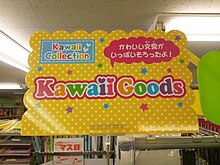
Kawaii appurtenances outlet in 100 yen store
There have been occasions on which popular Western products failed to see the expectations of kawaii, and thus did non do well in the Japanese market place. For example, Cabbage Patch Kids dolls did not sell well in Japan, because the Japanese considered their facial features to be "ugly" and "grotesque" compared to the flatter and virtually featureless faces of characters such as Hullo Kitty.[11] Besides, the doll Barbie, portraying an adult woman, did not become successful in Japan compared to Takara's Licca, a doll that was modeled after an xi-twelvemonth-onetime girl.[11]
Manufacture [edit]
Kawaii has gradually gone from a small subculture in Japan to an important office of Japanese modern culture every bit a whole. An overwhelming number of modern items feature kawaii themes, not only in Japan but also worldwide.[36] And characters associated with kawaii are astoundingly popular. "Global cuteness" is reflected in such billion-dollar sellers every bit Pokémon and Hello Kitty.[37] "Fueled by Internet subcultures, Hullo Kitty alone has hundreds of entries on eBay, and is selling in more than 30 countries, including Argentine republic, Bahrain, and Taiwan."[37]
Japan has become a powerhouse in the kawaii industry and images of Doraemon, How-do-you-do Kitty, Pikachu, Crewman Moon and Hamtaro are pop in mobile phone accessories. Even so, Professor Tian Shenliang says that Japan's future is dependent on how much of an affect kawaii brings to humanity.[38]
The Japanese Foreign Ministry has too recognized the power of beautiful merchandise and has sent three eighteen-year-onetime women overseas in the hopes of spreading Japanese culture effectually the earth. The women dress in uniforms and maid costumes that are commonplace in Japan.[39]
Kawaii manga and magazines accept brought tremendous profit to the Japanese press industry.[ citation needed ] Moreover, the worldwide revenue from the estimator game and its merchandising peripherals are closing in on $5 billion, according to a Nintendo press release titled "It'southward a Pokémon Planet".[37]
Influence upon other cultures [edit]
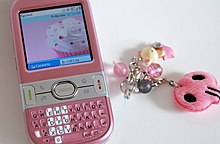
Kawaii keychain accessory attached to a pink western (early on model) smartphone
In recent years, Kawaii products take gained popularity beyond the borders of Japan in other Due east and Southeast Asian countries, and are additionally becoming more popular in the The states amid anime and manga fans as well equally others influenced past Japanese culture. Cute merchandise and products are especially popular in other parts of East Asia, such as mainland china, Hong Kong, Macau, Taiwan and South Korea, as well as Southeast Asian countries including the Philippines, Singapore, Thailand, and Vietnam.[31] [twoscore]
Sebastian Masuda, owner of half dozen%DOKIDOKI and a global abet for kawaii influence, takes the quality from Harajuku to Western markets in his stores and artwork. The underlying belief of this Japanese designer is that "kawaii" really saves the world.[41] The infusion of kawaii into other world markets and cultures is accomplished by introducing kawaii via modern fine art; sound, visual, and written media; and the fashion trends of Japanese youth, especially in high school girls.[42]
Japanese kawaii seemingly operates equally a center of global popularity due to its clan with making cultural productions and consumer products "beautiful". This mindset pursues a global market,[43] giving rise to numerous applications and interpretations in other cultures.
The dissemination of Japanese youth way and "kawaii culture" is normally associated with the Western society and trends set by designers borrowed or taken from Nippon.[42] With the emergence of China, South korea and Singapore as global economic centers, the Kawaii merchandise and production popularity has shifted back to the East. In these East Asian and Southeast Asian markets, the kawaii concept takes on various forms and unlike types of presentation depending on the target audience.
In Due east Asia and Southeast Asia [edit]
Taiwanese civilization, the government in particular, has embraced and elevated kawaii to a new level of social consciousness. The introduction of the A-Bian doll was seen as the development of a symbol to advance democracy and assistance in constructing a collective imagination and national identity for Taiwanese people. The A-Bian dolls are kawaii likeness of sports figure, famous individuals, and at present political figures that utilize kawaii images as a means of self-promotion and potential votes.[44] The creation of the A-Bian doll has allowed Taiwanese President Chen Shui-bian staffers to create a new civilisation where the "kawaii" image of a politico can be used to mobilize support and gain election votes.[45]
Japanese pop "kawaii culture" has had an effect on Singaporean youth. The emergence of Japanese culture can exist traced dorsum to the mid-1980s when Nihon became 1 of the economical powers in the world. Kawaii has developed from a few children's tv set shows to an Internet sensation.[46] Japanese media is used and so abundantly in Singapore that youths are more than likely to imitate the way of their Japanese idols, learn the Japanese linguistic communication, and go along purchasing Japanese oriented merchandise.[47]
The East Asian countries of china, Hong Kong, Taiwan and South Korea, as well as the Southeast Asian state of Thailand either produce kawaii items for international consumption or have websites that cater for kawaii as part of the youth culture in their country. Kawaii has taken on a life of its own, spawning the germination of kawaii websites, kawaii dwelling house pages, kawaii browser themes and finally, kawaii social networking pages. While Japan is the origin and Mecca of all things kawaii, artists and businesses around the world are imitating the kawaii theme.[48]
Kawaii has truly become "greater" than itself. The interconnectedness of today's earth via the Net has taken kawaii to new heights of exposure and acceptance, producing a kawaii "movement".[48]
The Kawaii concept has go something of a global miracle. The aesthetic cuteness of Japan is very appealing to people globally. The broad popularity of Japanese kawaii is oftentimes credited with it being "culturally odorless". The elimination of exoticism and national branding has helped kawaii to achieve numerous target audiences and span every culture, class, and gender group.[49] The palatable characteristics of kawaii take fabricated it a global hit, resulting in Japan's global paradigm shifting from existence known for austere rock gardens to being known for "cute-worship".[14]
In 2014, the Collins English Dictionary in the United Kingdom entered "kawaii" into its then latest edition, defining it as a "Japanese artistic and cultural style that emphasizes the quality of cuteness, using bright colours and characters with a childlike appearance".[50]
Controversy [edit]
In his volume The Power of Beautiful, Simon May talks nearly the 180 caste turn in Japan'due south history, from the violence of war to kawaii starting around the 1970s, in the works of artists similar Takashi Murakami, amid others. By 1992, kawaii was seen equally "the most widely used, widely loved, habitual word in modern living Japanese."[51] Since and then, there has been some controversy surrounding the term kawaii and the expectations of information technology in Japanese culture. Natalia Konstantinovskaia, in her article "Existence Kawaii in Japan", says that based on the increasing ratio of young Japanese girls that view themselves as kawaii, there is a possibility that "from early childhood, Japanese people are socialized into the expectation that women must be kawaii."[52] The thought of kawaii can be catchy to balance - if a woman'due south interpretation of kawaii seems to take gone too far, she is and so labeled equally buriko, "a adult female who plays bogus innocence."[52] In the commodity "Embodied Kawaii: Girls' voices in J-pop", the authors make the argument that female J-pop singers are expected to be recognizable by their outfits, voice, and mannerisms as kawaii - young and cute. Any woman who becomes a J-popular icon must stay kawaii, or keep her girlishness, rather than being perceived as a woman, even if she is over 18.[53]
See also [edit]
 | Wikiquote has quotations related to: Kawaii |
- Aegyo
- Army camp (way)
- Chibi (slang)
- Culture of Japan
- Ingénue
- Kawaii metal, Kawaii bass (Music genre)
- Moe
- Yuru-chara
References [edit]
- ^ The Japanese Self in Cultural Logic Archived 2016-04-27 at the Wayback Automobile, by Takei Sugiyama Libre, c. 2004 University of Hawaii Press, ISBN 0-8248-2840-two, p. 86.
- ^ a b Kerr, Hui-Ying (23 November 2016). "What is kawaii – and why did the world fall for the 'cult of cute'?" Archived 2017-eleven-08 at the Wayback Machine, The Conversation.
- ^ "kawaii Archived 2011-11-28 at the Wayback Machine", Oxford Dictionaries Online.
- ^ Kim, T. Beautiful is an Describing word. Accessed May 7, 2011, from http://world wide web.guidetojapanese.org/adjectives.html Archived 2011-09-28 at the Wayback Machine
- ^ Okazaki, Manami and Johnson, Geoff (2013). Kawaii!: Japan's Culture of Cute. Prestel, p. eight.
- ^ Marcus, Aaron, 1943 (2017-10-xxx). Cuteness engineering : designing adorable products and services. ISBN9783319619613. OCLC 1008977081.
- ^ Diana Lee, "Inside Look at Japanese Cute Culture Archived 2005-x-25 at the Wayback Machine" (September ane, 2005).
- ^ かわいい. 語源由来辞典 (Dictionary of Etymology) (in Japanese). 5 September 2006. Archived from the original on 9 July 2014. Retrieved 20 September 2014.
- ^ 可愛い. デジタル大辞泉 (Digital Daijisen) (in Japanese). Archived from the original on 26 Oct 2014. Retrieved 20 September 2014.
- ^ 可愛いとは. 大辞林第3版(Daijirin third Ed.) (in Japanese). Archived from the original on four Nov 2013. Retrieved 20 September 2014.
- ^ a b c d due east Shiokawa. "Beautiful But Deadly: Women and Violence in Japanese Comics". Themes and Problems in Asian Cartooning: Beautiful, Cheap, Mad and Sexy. Ed. John A. Lent. Bowling Greenish, Kentucky: Bowling Green State University Popular Press, 1999. 93–125. ISBN 0-87972-779-9.
- ^ a b c d e f m h i Kinsella, Sharon. 1995. "Cuties in Nippon" [one] Archived 2011-05-14 at the Wayback Car accessed Baronial 1, 2009.
- ^ Skov, L. (1995). Women, media, and consumption in Nippon. Hawai'i Press, United states of america.
- ^ a b c TheAge.Com: "Nihon smitten by honey of beautiful" http://www.theage.com.au/news/people/cool-or-infantile/2006/06/eighteen/1150569208424.html Archived 2006-06-22 at the Wayback Car
- ^ Ogawa, Takashi (25 December 2019). "Aichi exhibition showcases Rune Naito, pioneer of 'kawaii' civilization". Asahi Shimbun . Retrieved 14 January 2020.
- ^ "The New Breed of Kawaii – Characters Who Get Us". UmamiBrain. Archived from the original on 30 September 2017. Retrieved 29 September 2017.
- ^ Meet "Archived copy". Archived from the original on 2010-11-24. Retrieved 2009-02-12 .
{{cite web}}: CS1 maint: archived copy as championship (link) URL accessed February 11, 2009. - ^ Time Asia: Young Nippon: She's a textile daughter http://www.time.com/time/asia/asia/magazine/1999/990503/style1.html Archived 2001-01-28 at the Wayback Machine
- ^ Quotes and paraphrases from: Yuri Kageyama (June 14, 2006). "Cuteness a hot-selling commodity in Nihon". Associated Press. Archived from the original on October 15, 2017. Retrieved September 2, 2017.
- ^ Merry White (29 September 1994). The fabric child: coming of age in Japan and America . University of California Printing. pp. 129. ISBN978-0-520-08940-ii . Retrieved 19 July 2011.
- ^ a b "You are doing urikko!: Censoring/scrutinizing artificers of cute femininity in Japanese," Laura Miller in Japanese Language, Gender, and Ideology: Cultural Models and Real People, edited by Janet Shibamoto Smith and Shigeko Okamoto, Oxford University Press, 2004. In Japanese.
- ^ a b Bloomberg Businessweek, "In Japan, Cute Conquers All" Archived 2017-04-24 at the Wayback Automobile.
- ^ RiRi, Madame. "Some Japanese customs that may confuse foreigners". Japan Today. Archived from the original on 19 July 2013. Retrieved 25 March 2013.
- ^ "Momoiro Clover Z dazzles audiences with shiny letters of promise". The Asahi Shimbun. 2012-08-29. Archived from the original on 2013-10-24.
- ^ a b Fort, Emeline (2010). A Guide to Japanese Street Fashion. 6 Degrees.
- ^ Holson, Laura M. (13 March 2005). "Gothic Lolitas: Demure vs. Dominatrix". The New York Times.
- ^ a b Fort, Emmeline (2010). A Guide to Japanese Street Style. half-dozen Degrees.
- ^ Mitani, Koki (29 May 2004). "Kamikaze Girls". IMDB. Archived from the original on 2018-09-15. Retrieved 2018-07-21 .
- ^ a b Suzuki, Kirin. "Makeup Changes Men". Tokyo Kawaii, Etc. Archived from the original on 21 July 2013. Retrieved eleven April 2013.
- ^ Bennette, Colette (18 November 2011). "It's all Kawaii: Cuteness in Japanese Civilization". CNN. Archived from the original on 2 July 2013. Retrieved eleven April 2013.
- ^ a b c d "Cute Inc". WIRED. December 1999. Archived from the original on 2012-10-20. Retrieved 2017-03-08 .
- ^ "Summit Ten Japanese Character Mascots". Finding Fukuoka. 2012-01-13. Archived from the original on 2013-12-02. Retrieved 2013-12-12 .
- ^ Nippon Post site showing mailbox mascot Archived 2006-02-21 at the Wayback Car URL accessed Apr nineteen, 2006.
- ^ Fourth dimension Asia: "Arts: Kwest For Kawaii". Retrieved on 2006-04-19 from http://world wide web.time.com/time/asia/arts/magazine/0,9754,131022,00.html Archived 2006-02-21 at the Wayback Automobile.
- ^ The New Yorker "FACT: SHOPPING REBELLION: What the kids want". Retrieved on 2006-04-19 from http://world wide web.newyorker.com/fact/content/?020318fa_FACT Archived 2002-03-xx at annal.today.
- ^ (Enquiry Paper) Kawaii: Culture of Cuteness Archived 2013-01-18 at the Wayback Machine
- ^ a b c Roach, Mary. "Cute Inc." Wired Dec. 1999. 01 May 2005 https://world wide web.wired.com/wired/annal/seven.12/cute_pr.html Archived 2013-07-xxx at the Wayback Machine
- ^ 卡哇伊熱潮 扭轉日本文化 Archived 2013-03-01 at the Wayback Automobile
- ^ "日本的"卡哇伊文化"_中国台湾网". Retrieved 5 July 2018.
- ^ "Cute Power!". Newsweek. seven November 1999. Retrieved 5 July 2018.
- ^ (Kataoka, 2010)
- ^ a b Tadao, T. "Dissemination of Japanese Young Fashion and Civilization to the World-Enjoyable Japanese Cute (Kawaii) Fashions Spreading to the World and its Significant". Sen-I Gakkaishi. 66 (7): 223–226.
- ^ Brown, J. (2011). "Re-framing 'Kawaii': Interrogating Global Anxieties Surrounding the Artful of 'Cute' in Japanese Fine art and Consumer Products". International Journal of the Image. 1 (2): 1–ten. doi:10.18848/2154-8560/CGP/v01i02/44194.
- ^ [i]A-Bian Family. http://world wide web.akibo.com.tw/home/gallery/mark/03.htm Archived 2012-04-26 at the Wayback Machine
- ^ Chuang, Y. C. (2011, September). "Kawaii in Taiwan politics". International Journal of Asia-Pacific Studies, 7(3). 1–16. Retrieved from hither Archived 2019-05-xv at the Wayback Auto
- ^ [2]All things Kawaii. http://www.allthingskawaii.net/links/ Archived 2011-11-26 at the Wayback Motorcar
- ^ Hao, X., Teh, L.L. (2004). "The affect of japanese popular civilisation on the Singaporean youth". Keio Advice Review, 24. 17–32. Retrieved from: http://www.mediacom.keio.air conditioning.jp/publication/pdf2004/review26/3.pdf Archived 2012-04-26 at the Wayback Automobile
- ^ a b Rutledge, B. (2010, October). I love kawaii. Ibuki Magazine. 1–2. Retrieved from: http://ibukimagazine.com/lifestyle-/other-trends/212-i-love-kawaii Archived 2012-01-31 at the Wayback Machine
- ^ Shearin, 1000. (2011, October). Triumph of kawaii. William & Mary ideation. Retrieved from: http://www.wm.edu/research/ideation/ideation-stories-for-borrowing/2011/triumph-of-kawaii5221.php Archived 2012-01-31 at the Wayback Machine
- ^ "Kawaii culture in the UK: Japan'south tendency for cute". BBC News. 24 Oct 2014. Archived from the original on 27 October 2014. Retrieved 26 Oct 2014.
- ^ May, Simon (2019). The Ability of Cute. Princeton University Press. pp. 59–61.
- ^ a b Konstantinovskaia, Natalia (21 July 2017). "Being Kawaii in Japan". UCLA Study for the Center of Women.
{{cite web}}: CS1 maint: url-status (link) - ^ Keith, Sarah; Hughes, Diane (December 2016). "Embodied Kawaii: Girls' voices in J-pop: Hughes and Keith". Journal of Pop Music Studies. 28 (four): 474–487. doi:10.1111/jpms.12195.
Further reading [edit]
- Harris, Daniel (2001). Cute, quaint, hungry, and romantic: the aesthetics of consumerism. Boston, Massachusetts: Da Capo. ISBN9780306810473.
- Brehm, Margrit, ed. (2002). The Japanese experience: inevitable. Ostfildern-Ruit, Germany New York, New York: Hatje Cantz; Distributed Art Publishers. ISBN9783775712545.
- Cross, Gary (2004). The cute and the cool: wondrous innocence and modern American children'south culture. Oxford New York: Oxford University Press. ISBN9780195156669.
- Carpi, Giancarlo (2012). Gabriels and the Italian cute nymphet. Milan: Mazzotta. ISBN9788820219932.
- Nittono, Hiroshi; Fukushima, Michiko; Yano, Akihiro; Moriya, Hiroki (September 2012). "The power of kawaii: viewing cute images promotes a careful behavior and narrows attentional focus". PLOS One. 7 (9): e46362. Bibcode:2012PLoSO...746362N. doi:10.1371/journal.pone.0046362. PMC3458879. PMID 23050022.
- Asano-Cavanagh, Yuko (October 2014). "Linguistic manifestation of gender reinforcement through the use of the Japanese term kawaii". Gender and Language. 8 (three): 341–359. doi:10.1558/genl.v8i3.341.
- Ohkura, Michiko (2019). Kawaii Technology. Singapore: Springer. ISBN9789811379642.
0 Response to "Tokyo People Eating Dogs Tokyo Kawii Fashion"
Post a Comment